
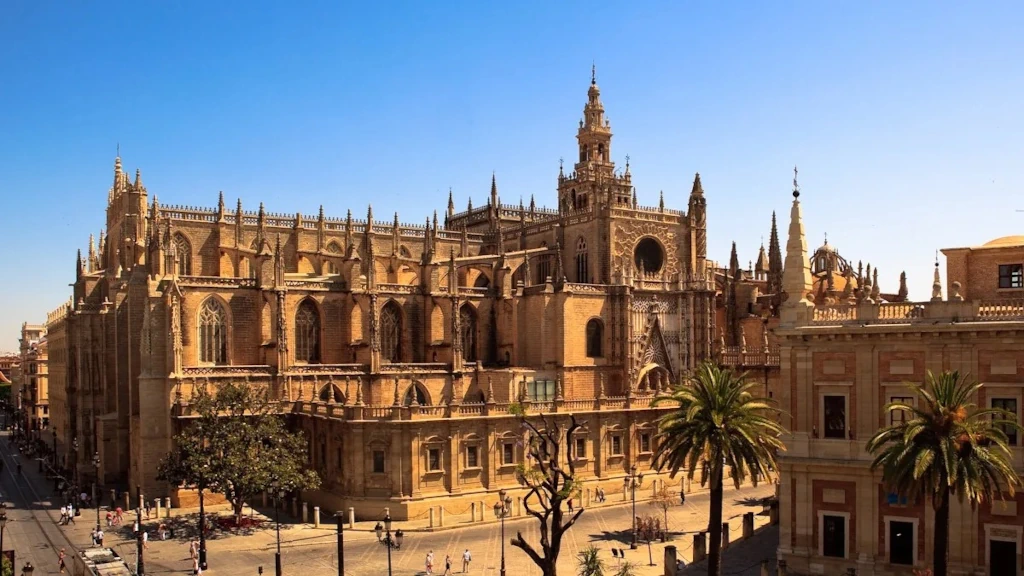
Seville Cathedral, categorized by its vastness as a “hollow mountain,” has maintained a historic structural fragility due to continuous resistance issues and volume fluctuations suffered by the weak stone of its ashlar blocks. Originally built on the site of the former 12th-century main mosque—from which the Giralda and the Patio de los Naranjos still endure—the current Gothic temple began construction in 1403 to endow the city with a monument of immense grandeur. The main building works concluded in the early 16th century following Juan Gil de Hontañón’s intervention on the lantern tower and transept vaults, with Renaissance and Baroque chapels and dependencies gradually added over time.
The deterioration of the stone and various earthquakes have jeopardized the support of the temple over the centuries, forcing an ongoing process of restoration that intensified in the 19th century. The most critical moment of this phase occurred on August 1, 1888, when the pillar on the front right corner of the choir collapsed due to compression, causing the traumatic collapse of the lantern tower and several adjacent vaults. This disaster, which raised fears for the overall stability of the building, spurred ambitious consolidation works directed by architects such as Adolfo Fernández Casanova and Joaquín Fernández Ayarragaray.
Alongside structural repairs, the basilica’s exterior appearance was progressively completed. On the western facade, the central portal of the Assumption was completed throughout the 19th century using cements and marble dust, a Neo-Gothic solution heavily criticized later by specialists of the era. Meanwhile, the transept gables remained unfinished and bare until the late 19th century, when Fernández Casanova designed the San Cristóbal and Concepción doors in Neo-Gothic style. These interventions also made it possible to correct severe construction flaws, such as the major cracks that separated the south wall from the buttresses and threatened the collapse of the facade.
During the 20th century and contemporary times, conservation efforts have continued uninterrupted. Between 1941 and 1949, Félix Hernández Jiménez recovered Almohad arcades in the Patio de los Naranjos that had been mutilated or walled up in earlier periods. More recently, under the direction of Alfonso Jiménez Martín, interventions have focused on removing deteriorated cement additions on the western elevation and addressing the replacement and reinforcement of the most damaged pillars in the retrochoir using temporary metallic structures, thus guaranteeing the stability of this stone giant.
The Giralda
The Giralda, the current bell tower of Seville Cathedral, began construction in 1172 under the reign of Almohad Caliph Abu Yaqub Yusuf as the minaret of the Great Mosque of Isbiliyya, under the initial direction of architect Ahmad ibn Baso. Designed as a prismatic tower of brick and lime over a Roman stone base sourced from the Abbacid alcázar, its internal structure features a hollowed-out central core with stacked rooms, encircled by an ascending ramp. After works were halted by the death of the Caliph in 1184, construction resumed in 1188 under his son Abu Yusuf Yaqub al-Mansur, culminating on March 10, 1198, with the placement of the yamur at its peak—a bronze finial featuring four impaled spheres.
With the Christian conquest of Seville in 1248, the minaret was converted into the bell tower of the new Church of Santa María de la Sede. The Almohad structure remained practically unchanged until an earthquake in 1356 destroyed the upper yamur. Following this loss, the temple undertook various defensive and functional renovations: in the year 1400, a clock and a Gothic belfry were installed above the upper section to house bells, and the Islamic battlement parapet was removed. The definitive transformation of the monument took place in 1558, when Hernán Ruiz conceived a Neoclassical top featuring Renaissance temples, raising the tower from its original 50.73 meters to 94.70 meters. Crowning this openwork design, which contrasts with the Almohad body, the allegorical statue of Faith—popularly known as the Giraldillo—was placed atop in 1568.
Throughout the 17th and 18th centuries, the Giralda suffered multiple weather and seismic mishaps. Notable events include a lightning strike in 1724, consolidation restoration following the 1755 Lisbon earthquake led by Juan Núñez, and the 1765 installation of the clock designed by Fray José Cordero. In 1836, a violent hurricane and further lightning strikes forced repairs on balconies and biforas. However, the most significant architectural event occurred in 1884 with the strike of the so-called “artistic lightning bolt,” an electrical discharge that exposed the Almohad openings and prompted a major restoration project directed by Adolfo Fernández-Casanova and José Gestoso. Although the architects intended to strip away several later additions to restore its Islamic identity, the Royal Academy of San Fernando tempered the proposal, concluding interventions on biforas, facades, and interior ramp vaults in 1888.
In contemporary times, the tower has undergone continuous maintenance. In 1979, architect Alfonso Jiménez Martín initiated a comprehensive phased restoration ranging from the Giraldillo, weather vane, and lightning rod to the complete rehabilitation of the exterior facades and the clock section. These efforts concluded in the late 1980s with the incorporation of safety measures in windows and geotechnical studies on the stability of its foundation.
SOURCES:
- Soraluce Blond, J. R. (2008). History of Restored Architecture: From Antiquity to the Renaissance [Historia de la arquitectura restaurada: De la Antigüedad al Renacimiento]. Universidade da Coruña.